
The Greatest Minds ever?
Berlin around 1930 in another one of the Many Worlds

We all agree how bad the Nazis were. Piling on, let me add yet another horrible impact they had on humanity or at least Judaism. Part of this has been written before but some may have escaped folks so here goes.
Berlin in the late 1920’s may have had the most remarkable group of intellectuals ever. I’m not a history buff so would be interested in anyone’s thoughts on this. Is there a ranking somewhere? Starting from my wheelhouse, there were the “senior physicists” everybody who went to Berlin would want to talk to or learn from. There were twelve Nobel Prize winners who spent significant time there, including Einstein, Planck, and Nernst [can you name the 9 others?]. Then there were 5-6 people who were overlooked or just too smart to win a Nobel Prize. The most famous overlooked was Lise Meitner, but also the four leading Martians from Hungary — Szilárd, Teller, von Neumann, and Wigner — spent time there. As Subir Sarkar reminded me, Rudolph Peierls was there as was the jovial godfather of modern cosmology, George Gamow. We knew this: the Nazis had the greatest collection of scientists in the world, maybe in world history, and — in addition to everything else — they messed it up.
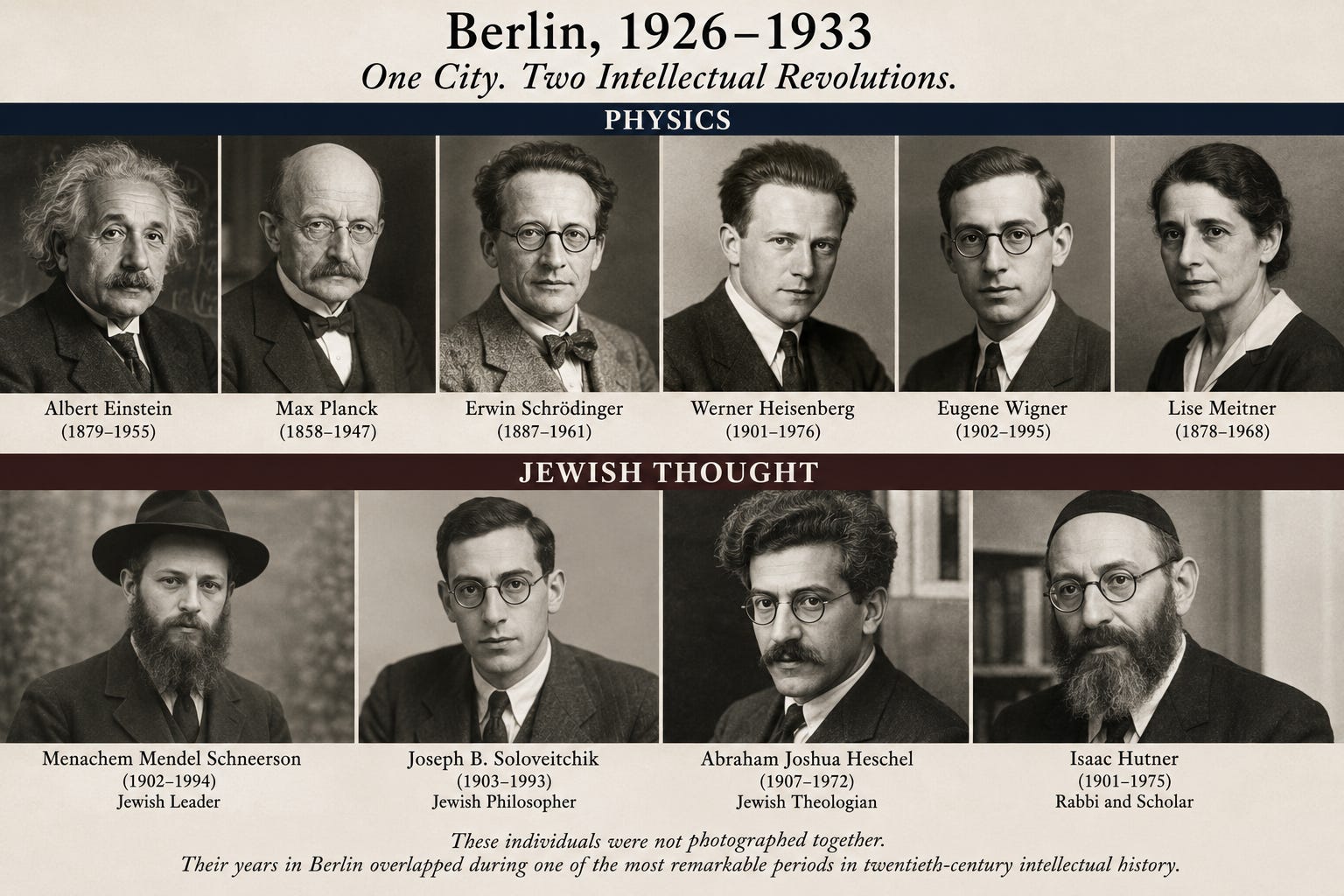
I never put two and two together though to appreciate that the greatest Jewish intellectuals of the 20th century were also in Berlin at that time. The two most famous were Menachem Mendel Schneerson, who studied math, physics, and philosophy at the university, enjoying Schrodinger’s lectures. All the while training to become the foremost Chasidic rabbi of the 20th century. Before getting his PhD, he had to leave to escape to France. He was good friends with Joseph Soloveitchik, who was able to stay long enough to receive his PhD, in philosophy not physics. Soloveitchik is definitely the most influential Orthodox Jewish thinker of the 20th century, and quite likely you can remove the “Orthodox” and the statement would still be true. I attended some of his lectures when I was starting to learn physics and was oscillating between physics and Judaica; he was the most impressive person I ever heard speak. Highly recommend his book “Lonely Man of Faith.” For good measure, Abraham Joshua Heschel was also there. He became another towering Jewish intellectual, and was influential in the US Civil Rights movement. Quoting from wikipedia:
Martin Luther King Jr. called Heschel "a truly great prophet." Heschel actively participated in the Civil Rights movement, and was a participant in the third Selma to Montgomery march, accompanying Dr. King and John Lewis.
Putting aside the horror of it all, imagine what could have been. If this group of people had been left alone to produce ideas in science and religion (and I’m sure I’m missing many from other religions and subject areas), what a better world we would be living in. From my very selfish point of view, it is possible that Judaism would have become more open to heretical ideas, those that changed the way we look at the world. After all, that is what the rabbis did in the Talmud. If the Many Worlds theory of quantum mechanics is right, there is a universe out there with Einstein, Soloveitchik, von Neumann, Schrodinger, … all working together.
Of what the hell; I asked an LLM to do it for us:
Berlin, 1930 (A Fiction)
Three men linger after a university lecture. The topic drifts unexpectedly—from quantum mechanics to a machine that can think.
Einstein: They tell me that one day there will be machines capable of answering almost any question.
Schrödinger: Then perhaps they will spare us students who never prepare for examinations.
(They laugh.)
Soloveitchik: They may answer questions, Professor. But can they ask the right ones?
Einstein: Ah! You already suspect my objection. Physics has taught us how to ask Nature precise questions. It has not taught us which questions deserve asking.
Schrödinger: Or whether Nature herself is the only thing worth questioning.
Soloveitchik: Judaism begins with a question addressed to man: “Ayeka?”—”Where are you?” It is not a request for information. It is a summons to responsibility.
A machine may know where I am. It cannot answer that question.
Einstein: So intelligence is not enough.
Soloveitchik: Intelligence is a gift. Responsibility is an achievement.
Schrödinger: We should also remember that understanding is not the same as calculation. Quantum mechanics already warns us against confusing a mathematical description with reality itself.
Einstein: Indeed. I would gladly accept a machine that could solve every differential equation. I would hesitate before asking it how to educate a child—or govern a nation.
Soloveitchik: Because wisdom cannot be delegated.
Schrödinger: Nor conscience.
(The bells of a nearby church strike the hour.)
Einstein: Then perhaps the machine’s greatest contribution will be this: it will force humanity to discover what only humanity can do.
Soloveitchik: If we remember that in time.
It is fun to speculate on what might have been, thank goodness there were countries willing to accept these fellows. How fortunate that many of them wrote popular books to make relativity and quantum mechanics understandable by the rest of us!
On the plus side, the Nazis ensured that many of these great scientists migrated westwards - profoundly changing the landscape of physics in North America and also in the UK. My own department experienced a renaissance: "... the enforced emigration of Jewish physicists from Nazi Germany and Central Europe in the 1930s and 1940s led to a number of eminent physicists settling in Oxford". We held a conference about this: The Émigrés in Oxford Physics (https://www.stx.ox.ac.uk/event/the-emigres-in-oxford-physics) - all the talks are on YouTube.