
I was wrong
COBE did not prove Cold Dark Matter

Michael Sinko was a graduate student at Carnegie Mellon when I was there, so we knew each other a bit and had some nice interactions. I’ve been trying to get readers by teasing these posts on various social media platforms, and Michael responded on X by asking: “Not certain I’m understanding your long paragraph about why it has to be cold. Is it because if it wasn’t cold, it wouldn’t be clumpy enough?”
It was nice to see that Michael is reading this stuff; one of the reasons for writing is to maintain connections with folks I used to see everyday. So thank you Michael for reading and keeping in touch. I hope you are doing well.
Besides that, the premise of his question is 100% correct, and I was wrong. As the subtitle of this post proclaims, COBE gave evidence for dark matter but no indication that it was hot (fast-moving) or cold (slow-moving). Claude Code helpfully produced this plot in a few minutes:
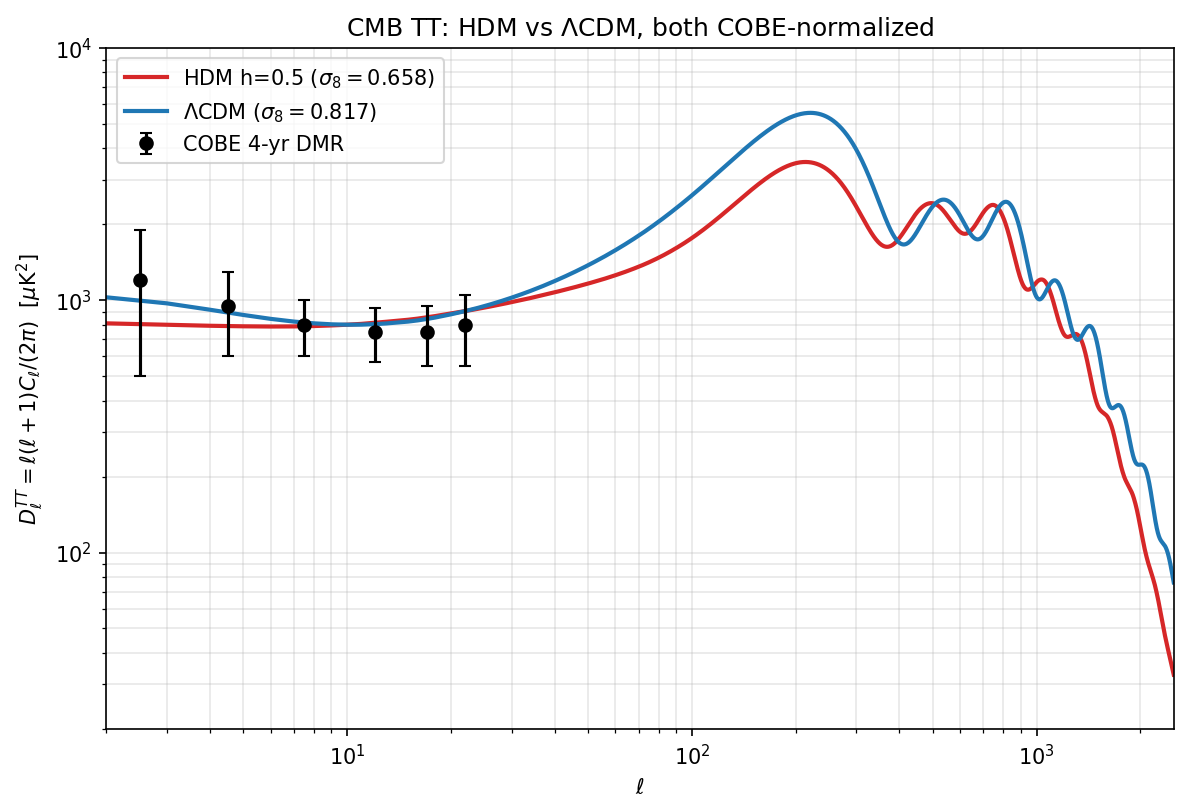
As you can see, both models — Hot Dark Matter and Cold Dark Matter — easily fit the COBE data. The “long paragraph” referred to made the point that without dark matter, there would not be enough structure in the universe today. Hot Dark Matter would have produced lots of galaxies, so would not have failed that qualitative test.
I love this, because it extracts a subtlety about how theories become accepted. As I mentioned in the previous posts, there were numerous review articles about the acceptance of Cold Dark Matter in the aftermath of COBE. The one whose title page I included there had “Cold Dark Matter” in the title. How then did the fact that dark matter was cold come to be accepted? It was not COBE; what was it?
During the 1980’s, a number of cosmologists had started the program of simulating the universe, putting in dark matter particles and allowing them to evolve under the influence of gravity. The figure below shows a snapshot from one effort, one of the more influential, to do this. The slice looks like the observed universe.
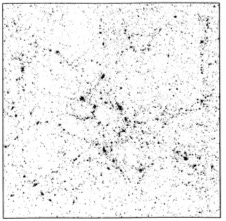
People did this with both cold and hot dark matter (the one above used CDM) and found that hot dark matter did not work, did not reproduce the universe qualitatively. They also quantified the simulations with statistics, but my sense is the statistics were not compelling, what was compelling was the pictures. I can’t find a great picture of hot dark matter because it failed so badly that people stopped working on it.
This was often framed as a debate between the tremendously influential Russian cosmologist Yakov Zeldovich, who advocated that structure formed “top-down,” first large structure grew and then smaller structures evolved from them, and the Western cosmologists who favored bottom-up scenarios. Bottom-up won, and the verdict was in before COBE. The thing that COBE did was give people confidence that the whole picture was right. A metaphor might be: some people thought Martians had two heads and some thought they had 3, and each brought forth lots of arguments for their opinions. Eventually, everybody realized that 3 heads was not biologically feasible. So the two-headed faction won. But that mattered a helluva lot more once Martians were discovered.
"Claude Code helpfully produced this plot in a few minutes" This made me chuckle. Somehow I didn't expect you to be using it because the professors of your experience I have seen in the recent years weren't using these tools. But perhaps this indicates that you are more active (in technical work and in learning new tools) than typical professors.