
Cosmological Constant

The fiducial cosmological model posits the existence of a non-zero value of the “cosmological constant.” Some questions from easiest to hardest: What is the cosmological constant? What is its apparent value? Is that value large or small? Why are people so troubled by it? How have people learned to overlook the difficulties?
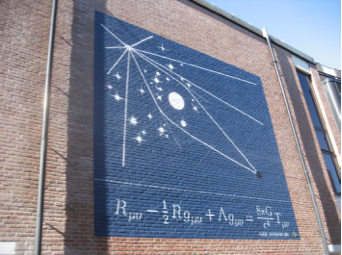
What is the cosmological constant? Einstein’s theory of general relativity can be expressed as the equality of two sets of terms, one quantifying geometry (the two terms on the left of the equal sign in the figure, the so-called Einstein tensor) and the other matter and energy (the term on the right, the energy-momentum tensor). Granted, those terms are complicated, and it takes a while to learn what they are and how to calculate them, but it’s only two things. A cosmological constant enters in the third term. For the experts, it’s the coefficient of the metric. The key point is: it’s an add-on, a term that could exist but there’s no real reason for it to be there; you could live without it. From time to time, over the course of the last 110 years, people have felt they could not live without it, so they put it in. We are living in one such time.
Where does it belong, on the geometry side or the energy side? The answer to that helps to address the question of what it really is. My feeling is that we understand it best if we group it with the energy terms. Then, when multiplied by a few known constants, it can be interpreted as the energy density of empty space. It’s not shocking that empty space has energy because we know that quantum mechanics allows for energy to pop in and out of existence for a brief moment. This is the essence of Heisenberg’s Uncertainty Principle. The simplest example of this is that the simplest of all physical systems — the harmonic oscillator — has a non-zero energy even when it is in its lowest energy state. The take-away is that the cosmological constant represents the energy of empty space, space in its lowest energy state.
What is the apparent value of the cosmological constant? It’s part of an energy density, so I could give it to you in energy per volume, or Joules per meter cubed. That wouldn’t mean much. It is more instructive to report it in relevant units. The simplest is: what fraction of the total energy density in the universe lies in the cosmological constant? The answer to that is 70%. That’s why we need it now: it’s a pretty large fraction of the universe’s total energy budget.
Is that value large or small? I guess you mean large or small compared to what we would predict if we calculated it using all the stuff we learned about quantum mechanics in the past 100 years. It’s very, very small. Our rough guesstimate of how big it should be is 120 orders of magnitude larger than it apparently is1. This is the cosmological constant problem. It is always worth quoting Steven Weinberg, who wrote in his 1989 article with that title: “Perhaps it is for want of other crises to worry about that interest is increasingly centered on one veritable crisis: theoretical expectations for the cosmological constant exceed observational limits by some 120 orders of magnitude.” Not sure that today we are in the position of “want of other crises” but the rest holds today: the prediction from our calculations is very wrong.
Why are people so troubled by it? We think we understand quantum mechanics and its relativistic generalization, quantum field theory. So a prediction that is so very wrong is just appalling. You might say: ok, I understand that it bothers you, but wouldn’t it bother you even if the universe had zero cosmological constant? Your prediction would be even wronger then. That’s correct, but. One could imagine that there is some symmetry that we have not yet figured out that requires the cosmological constant to vanish. But getting to a number that is non-zero, but smaller than expected by 1 with 120 zeros after it seems ridiculous.
And it is worse than that. The other constituents of the universe — matter and radiation — have energy densities that decrease as the universe expands. This makes sense: as the universe expands, there is the same amount of energy but more volume, so the energy densities go down. This means that early on, when the universe was much younger than today, the energy in the cosmological constant was much, much smaller than the other stuff. In the future, the cosmological constant will have much more energy than the other stuff. So, in addition to believing that the calculators are wrong, we have to believe that we are living in a special time, roughly the only time when the cosmological constant and the matter have similar energy densities. Coincidences like this have always been disturbing to physicists. We no longer believe we are living in a special place, at the center of the Solar System or the center of the Universe, and we recoil at the notion that we are living in a special time.
How have people come to overlook the difficulties? That is one of the reasons I starting writing here a few months ago, to understand how ΛCDM emerged as the consensus theory given the immensity of the cosmological constant problem. There is one piece that was in Weinberg’s initial paper. I don’t think explains it all but it certainly works for some people.
It is the Anthropic Principle: the notion that if the cosmological constant was not very small, we would not be here to observe it. To quote Weinberg, “the world is the way it is, at least in part, because otherwise there would be no one to ask why it is the way it is.” Many eminent scientists believe in some version of the Anthropic Principle, and that is certainly part of the reason that ΛCDM has emerged as the fiducial cosmological model.
It is not wise to argue with the Steven Weinberg and the many smart people who agree with him, but I think the Anthropic Principle is nuts. Or more politely, it is a major step backwards. Science is all about finding explanations for things. For example, why are our eyes sensitive to light emitted by the Sun? We could just say: that’s the way it is, and if it wasn’t like that, we never would have survived to ask the question. But that’s not the answer: the scientific answer is we evolved. Species that could detect light emitted by the Sun have a huge advantage over those who don’t. Another one: Why does the Sun shine at all? We could have just said, if it didn’t the planet would not have been not enough to support life and we would not be here to ask the question. But that would be missing all of nuclear physics that powers the Sun. Looking for reasons for things is what we do, how we move forward.
Not really saying anything new here; many scientists agree with me that the Anthropic Principle is dumb, and that is part of the story, really. The Anthropic Principle was enough for some people to overcome the cosmological constant, but not for others. So why does everybody now include the cosmological constant as part of the fiducial cosmological model?
The Weinberg article points out that it’s a bit more subtle than this. In the language of quantum field theory, the cosmological constant is the bare term, and the quantum corrections are those that are computed to be very large. The mystery in this way of thinking is why the bare term should have the opposite sign and be so close (to one part in 10^{120}) in magnitude to the quantum corrections.
I explained the Pantheon Supernova Observations using my epoch-dependent G model. The model has just two parameters: the 4D radius of the Universe and the G**(-alpha) dependence of the Absolute Luminosity of SN1a. I derived that to be alpha=3.0. That makes all photometric distances to be overestimated by G**(1.5). In HU G= G0 * (1+z) so, all distances are overestimated by (1+z)**1.5
Once you correct the distances, HU predicts the photometric distance with D(z) = R0 * z/(1+z)
where R0 = 14.5 GLY and H0 = 67.5 km/s/Mpc
That matches the CMB H0 and thus there is no Crisis In Cosmology left.
Of course, I also refuted NASA Laser Lunar Ranging analysis and SN1a based G-variability papers. They are of poor quality and made basic mistakes. SN1a papers keep the Stellar Candles Hypothesis (which is the same as the constant G hypothesis) and try to ascertain G variability. NASA has used the G-Constant determined Earth moment of inertia when trying to evaluate G-variability.
Those are basic mistakes.
Earth Temperature History was explained by having the Sun being born as a binary (0.3:0.7). The initial mass distribution was defined by the early Earth Temperature. The time of merger was defined by the current core isotope composition. I modified MESA code to accommodate variable G. When the Sun was born, G was 1.47 G0 (where G0 is the current value of G).
In other words, I created a better model than L-CDM (1 parameter instead of seven), debunked constraints on G variability. The only problem I have is that journal editors will simply reject my work without providing a single reason or a peer review.
Of course, my work also predicted all planets' and binary pulsars' precession and derived the SSB Reference Frame Absolute Velocity, using the Double Pulsar, to match the CMB dipole velocity of 368 km/s with 99.8% precision.
Why don't scientists engage with me and support the right of my theory to be part of the discussion? It is overdue.
Re. "What is the apparent value of the cosmological constant?", the value inferred from astronomical observations (e.g. of Type Ia supernovae) is in fact Λ ~ 2 H_0^2, where H_0 is the present Hubble expansion rate. This is ~70 km/s/Mpc - corresponding to a minuscule ~10^{-42} GeV in particle physics units - so is neither a constant nor has any connection to quantum field theory. It does however enter into every cosmological observation and is the only dimensionful quantity in the standard (FLRW) analysis framework ... so naturally sets the scale of Λ. Since the fraction of the critical energy density it makes up is \Omega_Λ = Λ/3 H_0^2, this is then as high as ~2/3 i.e. Λ becomes the dominant component of the Universe!
It should be clear from the above however that it has nothing to do with quantum field theory. We have known since Pauli's 1933 remark that "as is obvious from experience, the [zero-point energy] does not produce any gravitational field” - otherwise we would not be here today billions of years after the Big Bang, in a slowly expanding universe. It should have either recollapsed or gone into exponentially rapid expansion without end when the temperature dropped to around ~100 GeV (if not earlier) and the Standard Model vacuum energy began to dominate. As you say, the mystery of *why* it does not gravitate remains unsolved to this day ... but to completely ignore this huge embarrassment and nevertheless invoke a tiny Λ to explain the inferred cosmic acceleration in the ΛCDM model makes no sense at all!