
Cosmic Inflation
the boldest idea birthed by the marriage of cosmology and particle physics

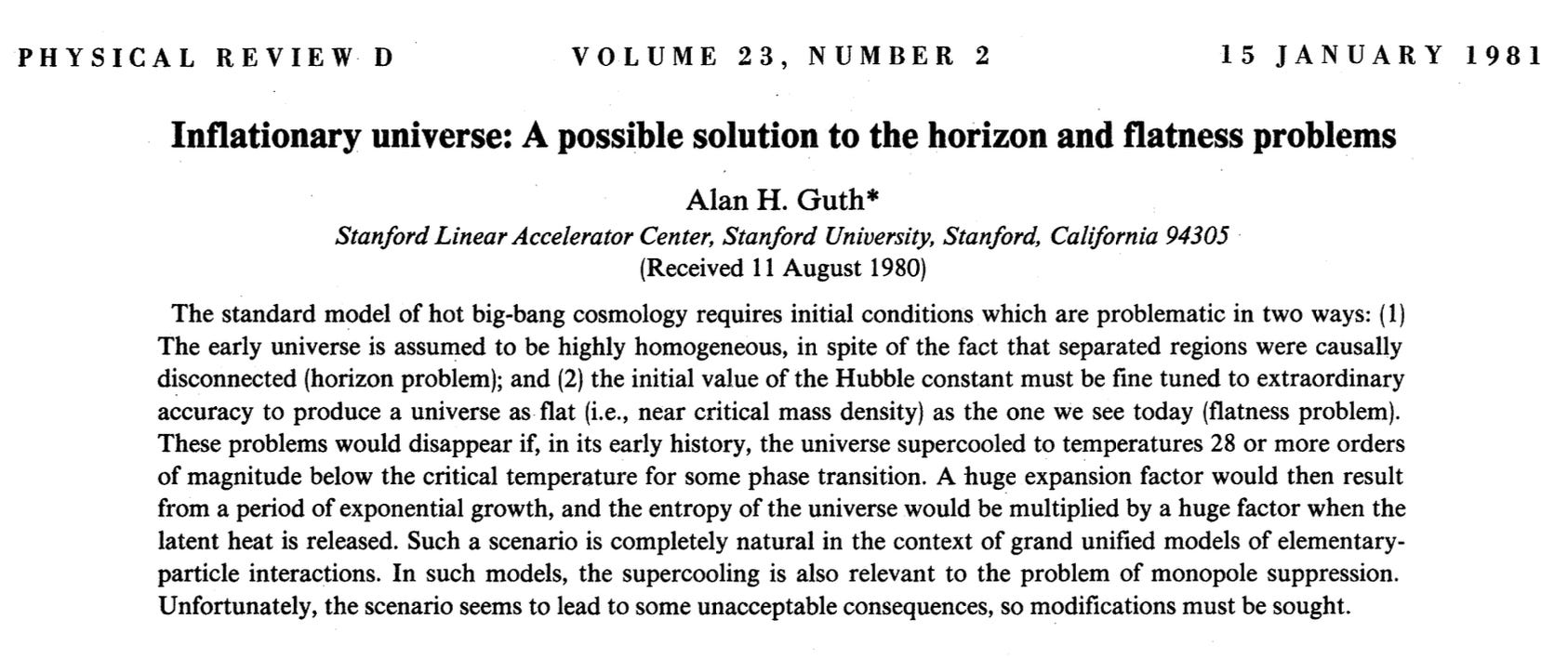
Inflation is the idea that very early in its history (when the universe was just a fraction of a second old), space expanded exponentially rapidly. Since Einstein’s theory of general relativity relates expansion to the stuff in the universe, exponential expansion must be driven by a particular form of energy. Nothing we know about could have done it, so inflation requires positing the existence of a new substance, or more technically a new quantum field. “New” here means it’s not one of the quantum fields that have already been discovered and are typically associated with particles: electrons, quarks, photons, etc. None of those could have driven inflation. It is possible, but extremely unlikely, that the Higgs boson drove inflation. It is also possible that whatever is driving the current epoch of accelerating expansion drove inflation, but that is even more unlikely. Rather, the field that drove inflation probably has a mass billions of times larger than anything ever discovered or anything that can be discovered by the most advanced colliders built or even imagined today.
So, if we have to make something up in order for inflation to work, why do so many people believe in it? This is a multi-part question: why do cosmologists believe that inflation is required? What problem does it solve? And then what else does it do? The question of why we believe in inflation is also a subset of a larger question: why do we believe anything? How does one idea get elevated to the status of assumed truth or shared belief?
Let’s begin by exploring what problem inflation was introduced to solve. The big one is the Horizon Problem. Recall that we have made a map of the cosmic microwave background (CMB), so we know what the universe looked like when it was only 380,000 years old. The map shown in the substack article linked to above is a bit misleading: it shows the small differences between the conditions at different places in the universe when it was only 380,000 years old, but the first observation is that the conditions were extraordinarily uniform: those differences are only at one part in ten thousand. So, back then, if one small region had 10,000 protons, another might have 10,001 or 9,998, but it would never have 10,010.
Why was the universe so uniform or homogeneous when it was young? One possibility is that the universe had “equilibrated” by that time. That is, a region with lots more stuff might have interacted with a region with less stuff and — as inevitably happens — things even out. Both regions, after interacting, would have the same amount of stuff. But there is a problem with this solution: in order for two regions to have interacted, they had to have been “causally connected.” That is, the particles in one region had to have time to migrate to the other. And there is an upper limit on how fast they can migrate: the speed of light. Light could only have traveled a finite distance, and the distance between different regions in the CMB map was far larger than that. So how did region A have the same conditions as region B?
Here’s a metaphor to try to convey the problem. You take a picture of lots of cars all moving away from each other. The people in the cars never talked to one another. Strangely, though, each car has exactly 1,000 balls in it. You notice a possible answer though: kids in each car are throwing balls out of their back windows at each other. Perhaps what happened is one car started off with lots of balls and over time, with the free flow of balls, the cars eventually got to an equilibrium situation, where each had the same number of balls. Well, this works but only if the speed of the balls is greater than the speed at which the cars are receding from one another. Suppose these kids have good arms and are throwing with a speed of 100 miles/hour. It turns out that the closer cars are to one another, the slower they are moving away, and the further they are, the faster they are receding from one another. (In fact, that is exactly the way the expansion of the universe works, as shown in the figure.)
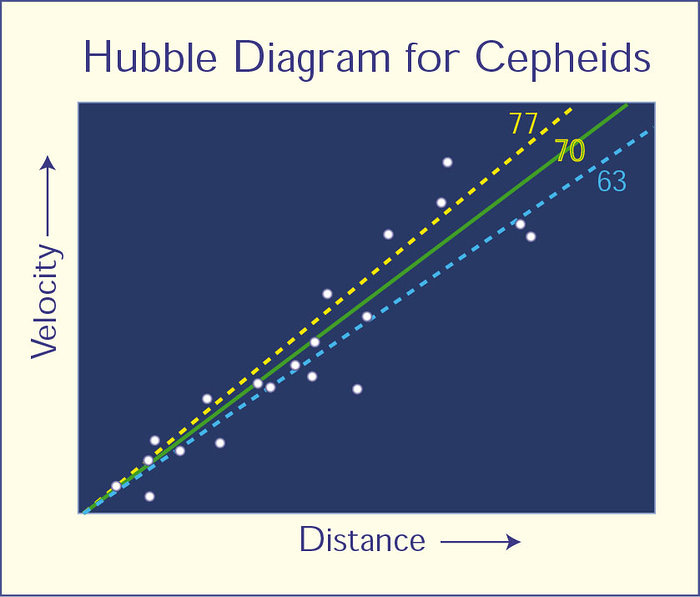
So, two cars that are pretty close are only moving away from one another at 2 miles/hour, and surely the reason they have the same number of balls is because of the equilibration due to those damned kids. But what about 2 cars separated by a large distance such that their recession velocity is 10,000 miles/hour. Those cars never equilibrated.1
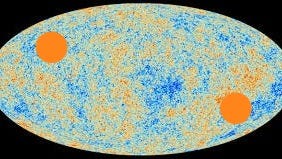
Anyway, that’s the horizon problem: there’s no way that distant regions in the CMB could have equilibrated when the universe was very young. As the map below indicates, two distant regions should not be causally connected: they should not have the same number of balls in them
There is a possible solution to this problem that turns out to be wrong: maybe the cars that are now far apart equilibrated early on when they were closer together and presumably moving away from one another at slower speeds. In the standard cosmology, with usual stuff in the universe, this doesn’t work. Let us call the distance that balls can travel in the time it takes cars to double the distance between them the Hubble radius. Both the Hubble radius and the distance between cars was smaller early on. Unfortunately, though, going back in time, the Hubble radius got smaller faster than the distance between cars. The ratio of the distance balls travelled in a short time to the distance the cars were moving away from one another was smaller early on. So balls actually had less chance to equilibrate early on.2
Guth’s solution was simple: maybe we were wrong about the behavior of the Hubble radius early on: maybe there was a brief time when it was not increasing, it was constant. Again rolling the movie backwards, the cars were getting closer and closer together but the balls were still traveling the same distance in a given time. Maybe the cars we now see as very far apart used to be very very close to one another. Maybe they all left from the same driveway. In that case, we can understand why they all have the same number of balls. It has nothing to do with the kids; the cars were loaded up initially with the same number of balls.
For this to work, there had to be a time early on when the Hubble radius, which is really just the inverse of the famous Hubble expansion rate, was constant. A constant Hubble rate leads to exponential expansion between objects in the universe3. And it is that requirement of a near-constant expansion rate that requires a new substance, one with very unusual properties.
On the one hand, it all sounds a bit crazy, extrapolating back to when the universe was a fraction of a second old, making up a new substance with weird properties that can never be detected today. On the other hand, this is what cosmologists were doing in the 1980’s. And Alan Guth was one of the best. And he was not the only one to propose inflation; the idea was in the air. Also, to be fair, there was a theory out there that seemed to be a decent candidate to produce the driving force of inflation. It turns out that none of those reasons explain why inflation is believed today. Since “why we believe” is what I’m interested in, next week, I’ll try to explain why inflation has lasted the test of time, while most of the other 1980’s cosmology-particle physics ideas have not.
You might object that equilibration can happen via a chain: 2 adjacent cars equilibrate and then the 3rd with the 2nd, 4th with the 3rd etc. But that doesn’t work: it would take way too long for the same reason.
Technically, the Hubble radius is
where c is the speed of light and a is the scale factor of the universe, which increase with time. Distances between objects scale as only one power of a, so if those distances were larger than the Hubble radius at the time when the CMB was formed, they were certainly larger at earlier times.
The Hubble expansion rate is ȧ/a. If that is constant, then a grows exponentially.
Scott, this is a wonderfully clear exposition of the horizon problem and the classical motivations for inflation. When you mention the necessity of positing a 'new substance' or quantum field, it’s worth considering that the inflaton might not need to be an ad hoc addition from particle physics at all. A highly compelling candidate for the inflaton is the scalaron, which emerges naturally from Quadratic Quantum Gravity. QQG has been a prime candidate for a perturbatively renormalizable theory of quantum gravity since before Guth's foundational work, though it was historically sidelined by the massive spin-2 ghost problem. With the physics of these ghost states now much better understood, QQG is receiving well-deserved fresh attention. If the inflaton is indeed the scalaron, it suggests that early exponential expansion was driven fundamentally by the quantum nature of gravity itself at high energies, rather than an arbitrary external field. If the inflaton is explicitly identified with the scalaron derived from a perturbatively renormalizable Quadratic Quantum Gravity framework, it shifts the foundational narrative of early-universe cosmology, including a purely geometric origin of inflation, and correspondence with evolving vacuum models. Unlike generic scalar-field inflation models, which often have enough free parameters to fit almost any data, scalaron-driven inflation (mapping to the Starobinsky $R^2$ model) is highly restrictive. It makes rigid predictions for the Cosmic Microwave Background, specifically a very low tensor-to-scalar ratio ($r \approx 0.003$ to $0.004$) and a specific tilt of the scalar spectral index ($n_s \approx 0.965$). This makes the identification exquisitely falsifiable using next-generation CMB polarization observatories.
Thanks, for this little gem. Nevertheless, I believe this quote is well-known to you: 'Be patient before reaching a decision; enable many students to stand on their own; make a fence around your teaching.' I have been thinking hard about reaching a decision, and whether I would dare act as a teacher in relation to your article, given that I am still a 'student' of modern cosmology. However, I believe I can now partly stand on my own, act as a teacher, and create a fence around my teaching of cosmic inflation, provided I am allowed to appeal to Occam’s razor and make use of a smooth extension of differential geometry into distribution geometry and the geon. This would, at the very least, open up a discussion concerning your opening paragraph. To understand this statement, may I invite you to read my published work in the journal Universe https://doi.org/10.3390/universe12040095
Finally, and once more thanks for your writing and teaching!